The Best No-Hardware Restaurant Pager System (2026)
What is a Modern Restaurant Pager System?
For the majority of full-service dining rooms and quick-service operations, the ideal restaurant pager system is no longer a physical fleet of plastic pucks. Instead, it is a cloud-based software system that sends a direct "buzz" to the guest’s own smartphone.
A traditional hardware restaurant pager system performs a very narrow job: notifying a party that their table or order is ready within a limited radio range. A guest’s phone handles vibration, audio alerts, and lock-screen notifications far more reliably than a $40 hardware coaster. Furthermore, moving to a digital restaurant pager system completely eliminates the need for bulky base stations, charging racks, and costly replacement orders when hardware goes missing.
Key Core Insights
Unreliable Hardware Specs
Coaster-based restaurant pager system ranges are calculated using line-of-sight metrics, not real-world layouts. Concrete walls and kitchen equipment frequently cause dead zones on patios or in waiting areas.
Party-Wide Alerts
Physical pucks notify only the single person holding them. A digital restaurant pager system shares a synchronized link with everyone in the party, allowing large groups to split up and browse nearby shops safely.
Hidden Operating Costs
The sticker price of a hardware restaurant pager system is only the baseline. Replacing lost or broken physical pucks costs $30 to $60 each, and ongoing battery maintenance adds recurring expenses year after year.
Deep-Dive Evaluation Metrics
When auditing a restaurant pager system for your host stand, look past basic brand-on-brand spec sheets and focus on how a busy weekend rush actually operates.
1. Real-World Range Limits
Hardware systems from legacy brands like JTECH boast open-air line-of-sight ranges of up to two miles. In practice, real building materials slash that performance significantly. A cloud-hosted restaurant pager system runs entirely on cellular data or Wi-Fi networks, discarding spatial line-of-sight constraints entirely.
2. Group Coordination
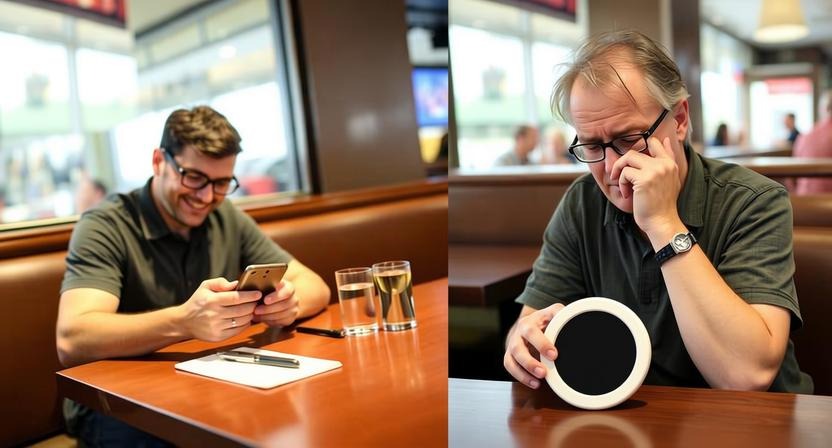
When seating large parties, a single physical buzzer forces one guest to manually track down the rest of their group. A phone-based restaurant pager system dispatches a simultaneous notification to every phone in the party, ensuring the entire table returns to the host stand at the exact same moment.
3. Structural Costs
A standard commercial coaster fleet requires an upfront layout of $800 to $2,000 for the base transmitter and 20 to 40 pagers. This triggers secondary maintenance loops for replacement hardware and battery refreshes. A no-hardware alternative removes the upfront hardware layer entirely.
4. Onboarding and Turnover
High seasonal staff turnover means training new hires constantly. Hardware networks require employees to master charging cycles, troubleshoot low-battery alerts, and manage physical inventory mid-shift. A digital QR-code or NFC-driven restaurant pager system relies on a basic "tap when ready" workflow that takes seconds to learn.
Comparing Pager Frameworks
Costs
Hardware systems require $800–$2,000 for equipment, plus ongoing replacement costs ($30–$60 per unit). Software-based, no-hardware systems eliminate these expenses.
Performance & Range
Physical coasters are constrained by physical barriers. Digital systems operate anywhere, using cell data or Wi-Fi.
Operational Efficiency
Digital solutions provide simultaneous alerts to all guests and, unlike hardware, remove the need for constant maintenance tracking.
A Friday Night Workflow Comparison
A modern digital restaurant pager system streamlines operations compared to legacy hardware. Guests scan a QR code to join the waitlist and track their status in real time via their own smartphone. Without the need to download an app, guests are free to leave the immediate premises, as the system provides alerts over the cellular network, ensuring they return promptly.
How TokenPager Solves This for Your Venue
TokenPager is designed from the ground up to be the ultimate, zero-hardware restaurant pager system. By letting customers join your queue and receive real-time page notifications directly on their mobile browsers via a simple QR code scan, TokenPager eliminates upfront hardware costs, replacement cycles, and device sanitization entirely. Whether you are running a busy metropolitan restaurant, a food truck, or a local cafe, TokenPager keeps your host stand running cleanly and efficiently, ensuring your guests can browse nearby shops or wait comfortably in their cars with unlimited signal range.
Ready to try TokenPager?
Create a free, contact-free customer pager workspace in seconds. Stop hardware overhead and phone spam today.